
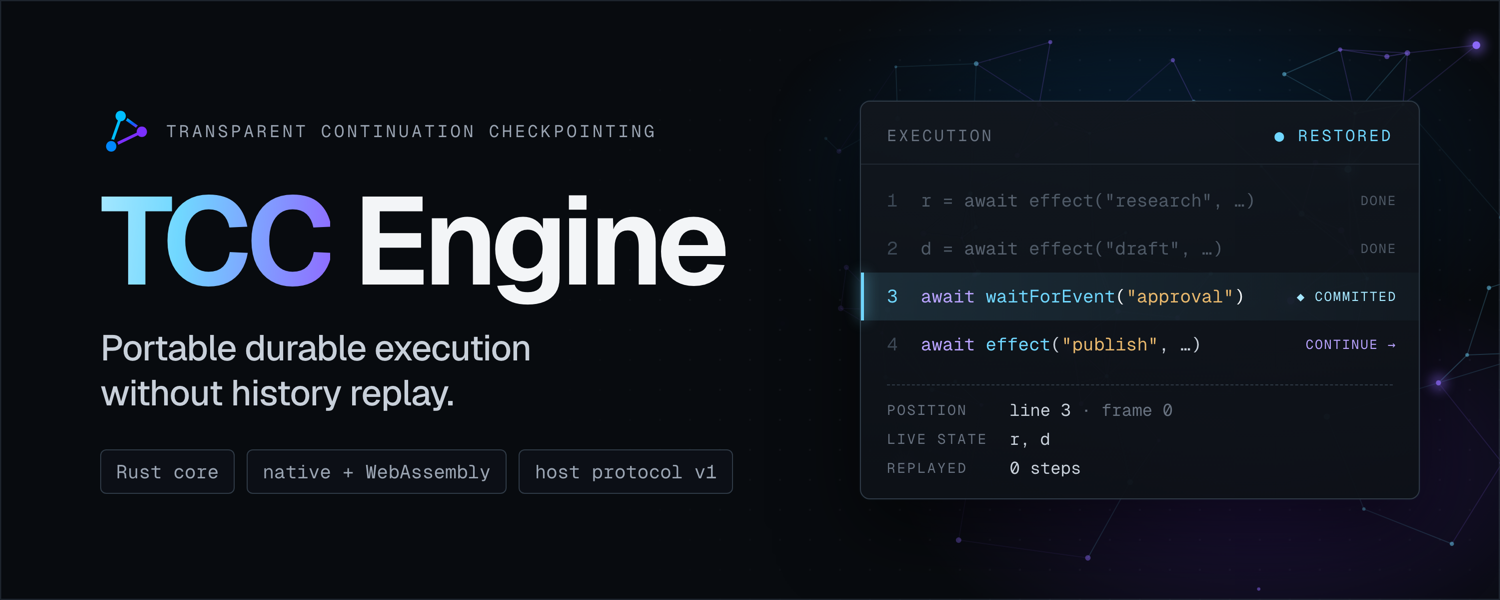
A portable compiler and runtime for durable execution from committed continuation state.
TCC—Transparent Continuation Checkpointing—records the program position and live values needed to continue execution. After a failure, a runtime restores that continuation and resumes without re-executing the completed prefix.
TCC Engine is the portable execution engine underlying Trigora. You can embed it directly for development, testing, evaluation, and other uses permitted by the license, or use Trigora for a managed production runtime.
The core is Rust. It builds natively and to WebAssembly. A host supplies persistence, external effects, event delivery, and scheduling.
Use Trigora when you want the product surface: language authoring packages, the CLI, and a managed production runtime. Start at trigora.dev.
Embed TCC Engine when you want the compiler and the native or WebAssembly binding in your own process. A host you write uses the published host crates. Guide: docs/embed.md.
The reference host is embeddable infrastructure, not a complete service: your process supplies effects, events, timers, and resume.
Trigora spelling compiles to the same durable operations as the engine-native imports.
| Language | Durable operations |
|---|---|
| TypeScript | @tcc-engine/primitives or @trigora/sdk |
| Python | tcc_engine.primitives or trigora |
| Rust | tcc_rust_prelude or trigora |
Programs use explicit durable operations. A language frontend compiles supported source into a TCC artifact. The engine executes the artifact and stops at durable boundaries for the host. After the host commits the required state, the execution can be restored from that continuation and the artifact that produced it.
A host may keep an execution history for inspection. Recovery does not use that history to reconstruct program state.
Recovery loads the latest committed continuation.
- A continuation is valid only with the artifact that produced it. The engine does not migrate executions onto incompatible code.
- Restore cost depends on continuation size and the host's persistence implementation. It is not specified as constant-time.
- An external operation may succeed before its result is committed. Ambiguous outcomes are represented explicitly; idempotency is the provider's and the application's responsibility.
- Supported language constructs are those accepted by a frontend. Arbitrary TypeScript, Python, Rust, or third-party libraries are not implied.
- Persistence, wakeup, and fencing guarantees are properties of the host.
A custom host talks host protocol v1 to the binding. It does not need the reference SQLite hosts or Trigora.
Host conformance v1 is a named claim: protocol versioning, artifact pinning, continuation reconstruction, and recovery after process termination at documented crash hooks. The kit is a generic runner plus host drivers. Semantic cases wrap the Node and Python SQLite adapters in this repository; a third-party host implements the same driver contract.
npm install @tcc-engine/frontend-typescript @tcc-engine/bindings-javascript@tcc-engine/bindings-javascript loads the engine through WebAssembly.
pip install tcc-enginetcc-engine includes the Python frontend, tcc_engine.primitives, and a SQLite host. Python support is 3.10–3.14. Free-threaded builds are not published.
cargo add tcc-ir tcc-state tcc-core tcc-host tcc-host-sqlite tcc-rust-frontendtcc-rust-frontend compiles Rust programs. A host you embed uses tcc-host and, for SQLite, tcc-host-sqlite.
The repository also contains workspace packages used by the TypeScript authoring frontend and Node reference host.
This repository is the engine, its specifications, compiler frontends, embeddings, reference hosts, and conformance kit. Use it to read the execution model, embed the engine, implement a host, or implement a language frontend.
| Path | Role |
|---|---|
primitives/ |
TypeScript authoring workspace package |
crates/tcc-ir |
Program representation and validation |
crates/tcc-state |
Values and continuation encoding |
crates/tcc-core |
Execution |
crates/tcc-host |
Host protocol types and driver |
crates/tcc-host-sqlite |
SQLite host |
crates/tcc-wasm |
WebAssembly exports |
crates/tcc-python |
Native Python (PyO3) embedding |
frontends/ |
TypeScript, Python, and Rust frontends |
bindings/ |
Language embeddings of the engine |
hosts/ |
Reference hosts |
conformance/ |
Host conformance v1 kit |
spec/ |
Specifications |
A frontend compiles source to a TCC artifact. A binding loads the engine in a host language. They are not the same thing.
The execution core does not depend on a particular database, cloud provider, or SDK. WASM is a delivery and conformance target for that core, not TCC itself. Native embedding is the other path. The WASM target is wasm32-unknown-unknown and does not use WASI networking, filesystems, or threads.
Requires a current stable Rust toolchain.
cargo test --workspace
cargo clippy --workspace --all-targets
pnpm install
pnpm --filter @tcc-engine/frontend-typescript test
cargo build -p tcc-wasm --target wasm32-unknown-unknown --release
node --experimental-strip-types --test hosts/node-memory/src/host.test.ts
pnpm --filter @tcc-engine/host-node testpython -m venv .venv
.venv/bin/pip install maturin pytest
( cd bindings/python && ../../.venv/bin/maturin develop )
.venv/bin/pytest frontends/python hosts/python- Host protocol
- Host conformance v1
- Durable operations
- Program format
- Execution semantics
- TypeScript subset
- Python subset
- Rust subset
- First example
- First example (Python)
- First example (Rust)
- Continuation format
- Compatibility
- Website: trigora.dev
- Cloud: cloud.trigora.dev
- Docs: trigora.dev/docs
- Research: trigora.dev/research
- GitHub: github.com/trigora-dev/trigora
TCC Engine is licensed under the Business Source License 1.1 (BUSL-1.1).
Production use is permitted under the Additional Use Grant subject to the license terms. Competitive hosted or embedded execution offerings may require a commercial license.
Each release converts to Apache License 2.0 on its Change Date.
See LICENSE for the full terms.
For commercial licensing: licensing@trigora.dev