
I come from a customer operations background and have spent more than six years working with user issues, complex cases, escalations, documentation and process-driven support.
Outside of work, I use Claude / Claude Code and OpenAI Codex to build software, investigate technical problems and operate self-hosted systems.
I am particularly interested in work at the intersection of:
customers · software · troubleshooting · implementation · product knowledge
The projects below show how I approach unfamiliar systems: understand the user's goal, narrow down the problem, use AI as a working partner, and verify the actual outcome rather than assuming that an implementation is correct.
Product ownership · AI-agent orchestration · testing · Windows · Rust
View the repository · Download the alpha release
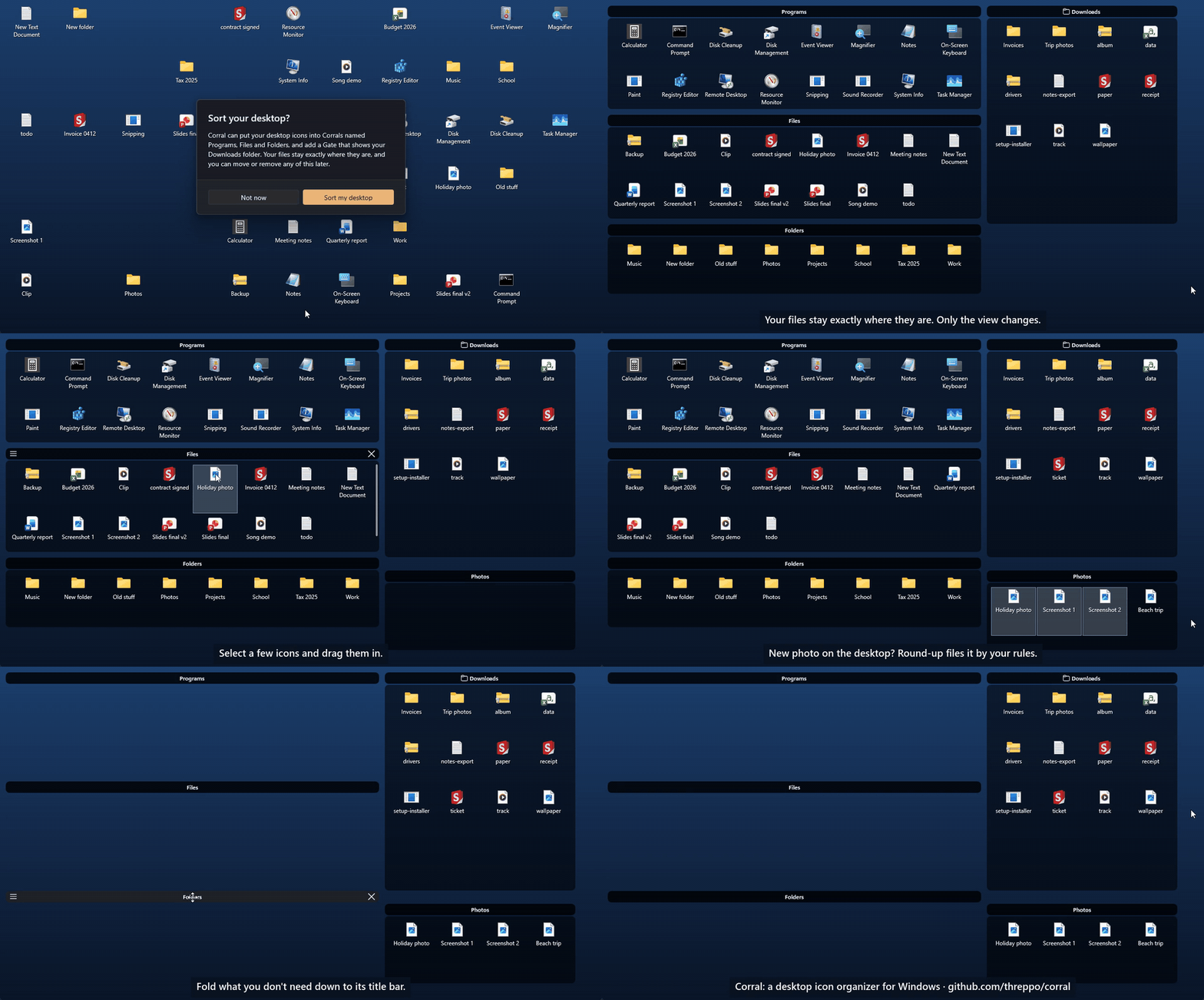
Corral is an open-source Windows desktop organizer designed as a free alternative to tools such as Fences.
It provides movable desktop containers, Folder Gates, automatic sorting rules, tabs, saved monitor layouts, appearance customization, Glance, Clear View and other desktop-management features.
I did not manually write the Rust code.
I acted primarily as the product owner, tester and AI-workflow orchestrator:
- defined the product goals and safety constraints;
- made product, UX and terminology decisions;
- tested the application on real Windows desktops and multiple displays;
- reported bugs and usability problems;
- reviewed agent findings and test results;
- approved or rejected changes before integration.
Claude Code acted as the lead technical agent, while Codex agents handled bounded implementation tasks and independent reviews in separate Git worktrees.
Changes capable of moving or deleting files received additional review because one of the core product requirements is that Corral must not unexpectedly modify a user's files.
During manual testing I discovered that dragging test files inside Corral's safe preview environment could unexpectedly move them onto the real Windows desktop.
The response was not simply to patch the visible symptom.
The process was:
check for data damage → reproduce → identify the boundary failure → implement a constrained fix → independent review → automated tests → repeat the original scenario manually
- product thinking;
- agent orchestration;
- structured QA;
- reproducing bugs;
- safety constraints;
- reviewing AI-generated work;
- knowing the difference between implemented, tested and verified.
Watch the main demo · Watch the settings tour · View verification records
API integration · mobile workflows · offline state · troubleshooting · AI-assisted development
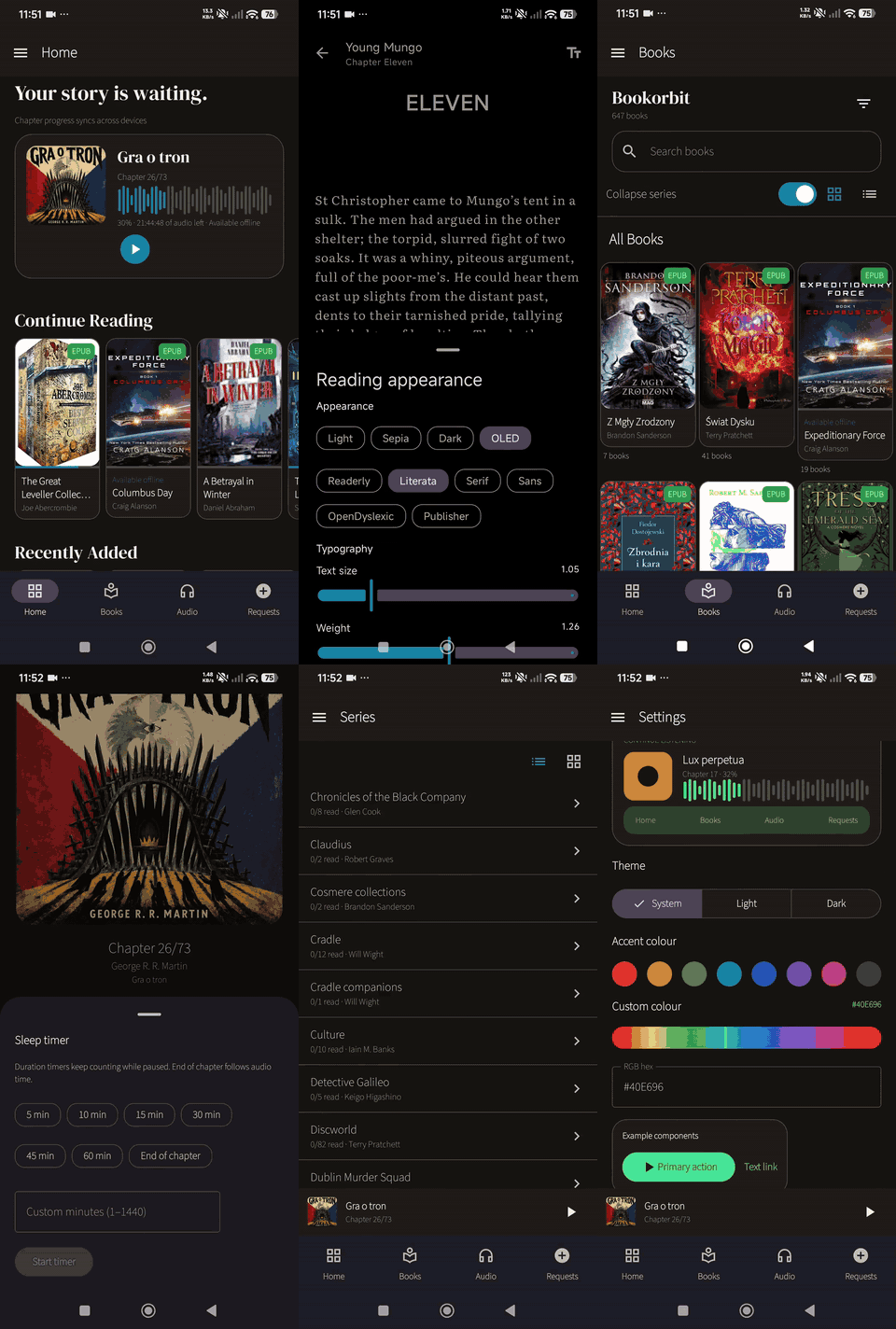
BookOrbit Android was my personal Android client for the self-hosted BookOrbit platform.
It began as a fork of an existing Android application rather than a project created from scratch. I substantially expanded it to work with the current BookOrbit server APIs and the workflows I actually use.
The resulting application supports areas including:
- authenticated audiobook streaming;
- multipart playback and chapter navigation;
- playback-state synchronization;
- downloads and offline playback;
- offline-first library caching;
- EPUB reading through Readium;
- reader customization;
- book requests and management workflows.
A feature such as audiobook resume can cross several layers:
server API → authentication → Android data model → player state → local persistence → synchronization → user interface
That made the project useful for learning how to follow a user-visible problem through an interconnected system instead of assuming that the screen displaying the problem is where the cause lives.
Claude / Claude Code and Codex assisted with investigation, implementation, testing and documentation.
My contribution centered on:
- defining expected behaviour;
- identifying useful workflows;
- describing failures and providing evidence;
- supplying server/API context;
- testing builds on a physical phone;
- rejecting incomplete fixes;
- deciding when the project had reached a useful stopping point.
The fork is now feature-complete for my personal use and is no longer under active feature development. Continued parallel development stopped after the upstream BookOrbit project moved toward official mobile clients.
The latest recorded development baseline included:
- 252 JVM unit tests passing;
- Android lint passing;
- successful debug build;
- selected physical-device reader verification.
Watch the 1m50s phone-recorded demo · Read the case studies · View the verification record
Linux · Docker · networking · backups · observability · AI-assisted operations
View the showcase · View the service map
I maintain a Debian-based homelab containing connected applications, databases, caches, monitoring, networking and recovery infrastructure.
The public repository is a sanitized export of the actual project: identifying information and private operational data are removed while preserving representative configuration, scripts and documentation.
The environment includes:
- Docker Compose services and container networking;
- application-specific databases and caches;
- public and private remote-access paths;
- a dedicated VPN route for selected workloads;
- monitoring, availability checks and logs;
- scheduled encrypted off-site backups;
- database-aware backup and recovery procedures.
My work is primarily deciding how the pieces should connect and what correct behaviour looks like, then using Claude/Codex to help investigate problems, implement scripts and verify the result.
A dashboard once returned authentication errors even though both relevant containers were running normally.
The investigation followed the failing integration instead of treating container health as proof that the system worked.
The issue was traced to a version rollback: the older application version expected authentication settings under different configuration keys.
The repair preserved the existing credentials, and verification was performed through the same dashboard API route that had originally failed.
- learning unfamiliar software;
- tracing failures across connected components;
- separating symptoms from causes;
- protecting existing data and configuration;
- backup and recovery thinking;
- using logs and observability;
- verifying the original user-visible outcome.
Read the AI workflow · Read the backup case study · View validation evidence
I do not treat AI as an answer generator or claim AI-generated implementation as manually authored work.
For larger technical tasks, my typical workflow is closer to:
goal → constraints → relevant context → investigation → implementation → independent review → verification
Depending on the project, I use:
- Claude / Claude Code for planning, investigation and implementation;
- OpenAI Codex for bounded tasks, parallel workers and reviews;
- separate Git branches/worktrees when parallel agents should not modify the same files;
- automated tests and focused manual checks before accepting changes.
I care more about giving an agent the correct context and acceptance criteria than finding a special prompt.
The final question is usually:
Did this actually solve the problem the user had?
rather than:
Did the model produce something that looks plausible?
Before these projects, my professional experience was primarily in customer operations.
I spent more than six years working on the Vinted project at Transcom, handling areas including:
- user support through ticketing systems;
- complex and non-standard cases;
- transaction disputes;
- damaged and missing parcel claims;
- moderation-related cases;
- information and documentation verification;
- escalations;
- cooperation with other teams and logistics partners.
For part of that period I also worked within a specialist six-person group handling more complex cases involving the Orlen Paczka carrier.
Earlier, I worked on a BGŻ BNP Paribas project involving customer-data and documentation verification within the credit process.
My degree is in Logistics from the University of Białystok.
Customer operations
ServiceNow · ticketing systems · Google Workspace · process-driven support
AI-assisted workflows
Claude · Claude Code · OpenAI Codex · Codex CLI · multi-agent workflows
Systems
Linux · Debian · Docker · Docker Compose · SSH · DNS · networking · Tailscale · Cloudflare Tunnel
Data and infrastructure
PostgreSQL · MariaDB · Redis · monitoring · backups · recovery
Product projects
Git · GitHub · APIs · testing · technical documentation · user-flow verification
Spreadsheets
Microsoft Excel · VLOOKUP · SUMIF/SUMIFS · PivotTables
I am especially interested in roles where a strong understanding of the customer and a willingness to investigate the underlying system are both useful, including:
- Technical Support
- Customer Support in technical SaaS products
- Implementation / Onboarding
- Customer Success with a technical component
- Application Support
- Product Operations
I am comfortable being the person who starts with:
“The customer says this does not work.”
and turns it into:
“Here is what is happening, here is how to reproduce it, here is the likely failing layer, and here is how we verified the fix.”
GitHub: github.com/threppo