
Nova Rio is temporary. It retires when Nova no longer needs it: when upstream Rio carries every delta below (or an equivalent), or when Nova replaces Nova Rio with Zellij's own terminal. Each delta lists its own removal condition. No delta has been proposed upstream yet, and that may never happen: as of October 2026, Zellij's own terminal window is close to release.
This is Yazelix Nova's minimal Rio
fork. The active edge branch starts from exact upstream revision
b2e7c38bdc56bb86b346ca4f37b9aeaa5151d790 (Rio 0.5.20) and carries only
twelve behavioral deltas:
-
Standalone distribution uses
nrio, independentnrioconfig directories,NRIO_CONFIG_HOME, and theNova Rio/com.yazelix.nova-rioapplication identity. The Nix overlay exportsnriowithout overridingpkgs.rio. Retire this identity delta when the fork is removed or upstream owns an independently selectable distribution identity. -
Nova's terminal look is the built-in base configuration (
rio-backend/src/config/nova/): borderless plain window, 0.70 opacity with blur and cell opacity, JetBrains Mono 16 with Nerd Font and Noto symbol maps, line height 1.12, trail cursor, and adaptivenova-dark/nova-lightpalettes. The user'sconfig.tomloverlays it key by key: tables merge, other values replace, and athemewithoutadaptive-themedrops the adaptive palettes. Explicit[colors]keys override the selected palettes. A missing or invalid file falls back to the embedded base, without loading user themes. Themes in the config directory'sthemeswin over the built-in Nova palettes. The Nix package supplies the fonts; other builds find them by family name. Retire this delta with thenrioidentity. -
Alternate-screen
CSI 2 Jclears obsolete direct Kitty placements. Remove this when upstream preserves the same main-screen scrollback boundary. -
Linux Vulkan image textures wait for submitted GPU work before freeing their descriptors and pixels on deletion, replacement, eviction, or shutdown. Remove this when upstream protects the same image lifetime. The upstream
b2e7c38destructor frees live descriptors; Yazi preview cleanup reproduces validation errorVUID-vkDestroyDescriptorPool-descriptorPool-00303. Verify image/video switching and popup hide/reopen in a fresh Rio with Vulkan validation enabled. Presentation semaphores belong to swapchain images, rather than frame slots, so reacquiring the image gates reuse. Intel Wayland reproduces upstream'sVUID-vkQueueSubmit-pSignalSemaphores-00067; retain this correction until upstream follows the same swapchain ownership through resize and shutdown. -
Odd and even vertical grid remainders are balanced through one shared grid origin. Remove this when upstream uses an equivalent origin for paint, input, graphics, cursors, and IME.
-
Explicit backgrounds of Unicode upper/lower half blocks (
▀/▄) stay opaque, matching their foreground samples, sowindow.opacity-cells = truedoes not stripe terminal artwork. Default-background sparse halves and ordinary TUI backgrounds retain their existing transparency. This corrects upstream behavior present inb2e7c38; current upstream59203ccdretains the same alpha routing inrio-grid. Remove this when upstream composites both samples consistently without changing normal text opacity. -
The compact quit prompt uses Nova's rounded orange treatment and measured, balanced spacing. Remove this when upstream styling is accepted as-is or exposes a native styling surface.
-
--theme-mode dark|lightselects the configured adaptive palette at launch and remains authoritative across config reloads. Remove this when upstream exposes an equivalent launch override. -
Native hints share Unicode-aware grid spans across mouse and keyboard input, follow terminal soft wraps, preserve configured OSC 8 actions and URI fields, and refresh hover feedback on modifier changes. Linux defaults to Ctrl-click; macOS retains Super-click. Link presses own their release ahead of application mouse reporting, and drags or stale targets cancel activation. Remove this delta when upstream provides the same matching and gesture behavior, with the accepted modifier available through native configuration.
-
Cursor trails obey the existing visibility, blink, focus, and IME policy. Hidden cursors discard their trail; the next visible position starts fresh. New animations request frames until they settle. Remove this delta when upstream passes the same hidden-cursor and idle-animation regressions.
-
Synchronized updates buffer drawing immediately after the begin marker, including payload in the same PTY read. The existing timeout and size bounds remain authoritative. Remove this delta when upstream passes the same chunk-boundary regression, including split Unicode and frame markers.
-
--config-editorvalidates TOML from stdin without loading assets or opening a window, then prints a version-1 TOML inventory of eight common global settings. Defaults are the effective values over Nova's built-in base, and accepted blur choices come from native config types; the complete native parser validates each candidate. Platform overrides retain precedence. This is RIO-CONFIG-UI-001, consumed by Nova Ratconfig. It is a finite editor surface, not a complete schema or an asset-availability check. Remove this delta when upstream provides an equivalent headless inventory and validator.
The config-editor mechanism was reviewed against upstream b2e7c38 and
6b0f5c8a: the existing --write-config writes a file but provides no editor
inventory or candidate validation. The editor adds no dependencies.
Run its contract with cargo test -p rio-backend -p rioterm --features rioterm/wgpu config_editor_uses_native_defaults_and_validation.
The base overlay regressions are
cargo test -p rio-backend -p rioterm --features rioterm/wgpu nova_.
The half-block regression is
cargo test -p rioterm --features wgpu half_block_compositing.
Run python3 misc/scripts/test-half-block-opacity.py in a fresh candidate Rio
with at least 14 rows, window.opacity = 0.7, and window.opacity-cells = true:
equal-color columns must be flat, distinct samples must reverse between
upper/lower blocks, and sparse halves and normal text backgrounds must retain
translucency. Repeat
with odd/even cell heights, full opacity, and cell opacity disabled. Selection
and cursor colors retain their existing overrides. The policy keeps explicitly
colored half-block artwork opaque; uniformly translucent artwork would require
coverage-aware compositing rather than applying alpha to two overlaid passes.
Nova consumes exact commits rather than a moving branch. The crates, native
configuration schema, terminal type (rio / xterm-rio), and all behavior
outside these twelve deltas remain upstream-owned. Mars features and Yazelix
Cursors are intentionally absent.
The hyperlink mechanism was reviewed against upstream b2e7c38 and historical
Mars commits 2177a794e7 (matching) and 9dc93ee46e (paired click ownership).
Rio's native hints, grid text/wrap helpers, and structured platform opener remain
the owners; no Mars input subsystem or shell launcher is imported.
Upstream b2e7c38 reproduces the hidden-cursor defect. The fork was also checked
with Yazi and timing-stressed Codex through Nova Zellij. Run the regression with
cargo test -p rioterm --features wgpu hidden_trail_restarts and the visual probe
with python3 misc/scripts/test-cursor-trail.py in the installed terminal.
Hidden phases must show no cursor; revealing it must not animate from the hidden
position, and visible moves must settle while terminal output is idle.
Synchronized repaint phases must keep the visible cursor steady. Their parser
regression is cargo test -p rio-vt sync_update_buffers_payload.
The supported fork installation is the Nix flake on Linux and macOS:
nix profile add github:Yazelix/nova-rio/edge#nrio
nrio
Pin an exact commit in a consumer lock file. Home Manager users add
inputs.nova-rio.packages.${pkgs.stdenv.hostPlatform.system}.nrio to
home.packages; keep the upstream Rio package and configuration independent.
The overlay exports pkgs.nrio, leaving pkgs.rio alone.
The fork reads $XDG_CONFIG_HOME/nrio/config.toml on Linux (default
~/.config/nrio/config.toml) and ~/.config/nrio/config.toml on macOS.
NRIO_CONFIG_HOME overrides that directory. Upstream RIO_CONFIG_HOME has no
effect on the fork. The native configuration schema and --write-config
remain Rio's; unset keys take Nova's built-in look. No existing Rio config is
migrated or rewritten.
Warning
The built-in look turns off scrollback (scrollback-history-limit = 0),
because Nova's Zellij keeps it. If nrio runs a plain shell instead of
yzx enter, set scrollback-history-limit = 10000 (upstream Rio's default)
in config.toml.
Linux installs com.yazelix.nova-rio.desktop, titled Nova Rio, with its own
nrio icon and application ID; macOS installs NovaRio.app with bundle ID
com.yazelix.nova-rio and the nrio URL scheme. These coexist with upstream's
identities. The terminal capability names remain upstream's for compatibility.
On Linux, nrio adds the package's Mesa Vulkan drivers to standard driver
discovery (VK_ADD_DRIVER_FILES), so it opens outside NixOS. Host drivers stay
visible, and an explicit VK_ADD_DRIVER_FILES, VK_DRIVER_FILES or
VK_ICD_FILENAMES keeps Vulkan Loader precedence.
To use a separately installed no-Rio Nova archive, set the fork's native config:
[shell]
program = "/absolute/path/to/archive/bin/yzx"
args = ["enter"]
Use an absolute installed archive path or its stable installation symlink.
The full Nova package already selects its pinned fork and Nova-owned config;
it does not expose nrio on PATH. The no-Rio archive still omits Rio.
nix build .#checks.x86_64-linux.coexistence checks both packages, independent
config creation, and the Linux Vulkan driver wrapper. Native Darwin checks use checks.aarch64-darwin.coexistence;
Linux evaluation alone does not prove macOS behavior. Other inherited upstream
packaging recipes are not a supported Nova release channel.

Rio is a modern terminal built to run everywhere.
About
·
Install
·
Config
·
Changelog
·
Sponsor
Documentation: rioterm.com.
If you use and like Rio, please consider sponsoring it: your support helps to cover the fees required to maintain the project and to validate the time spent working on it!


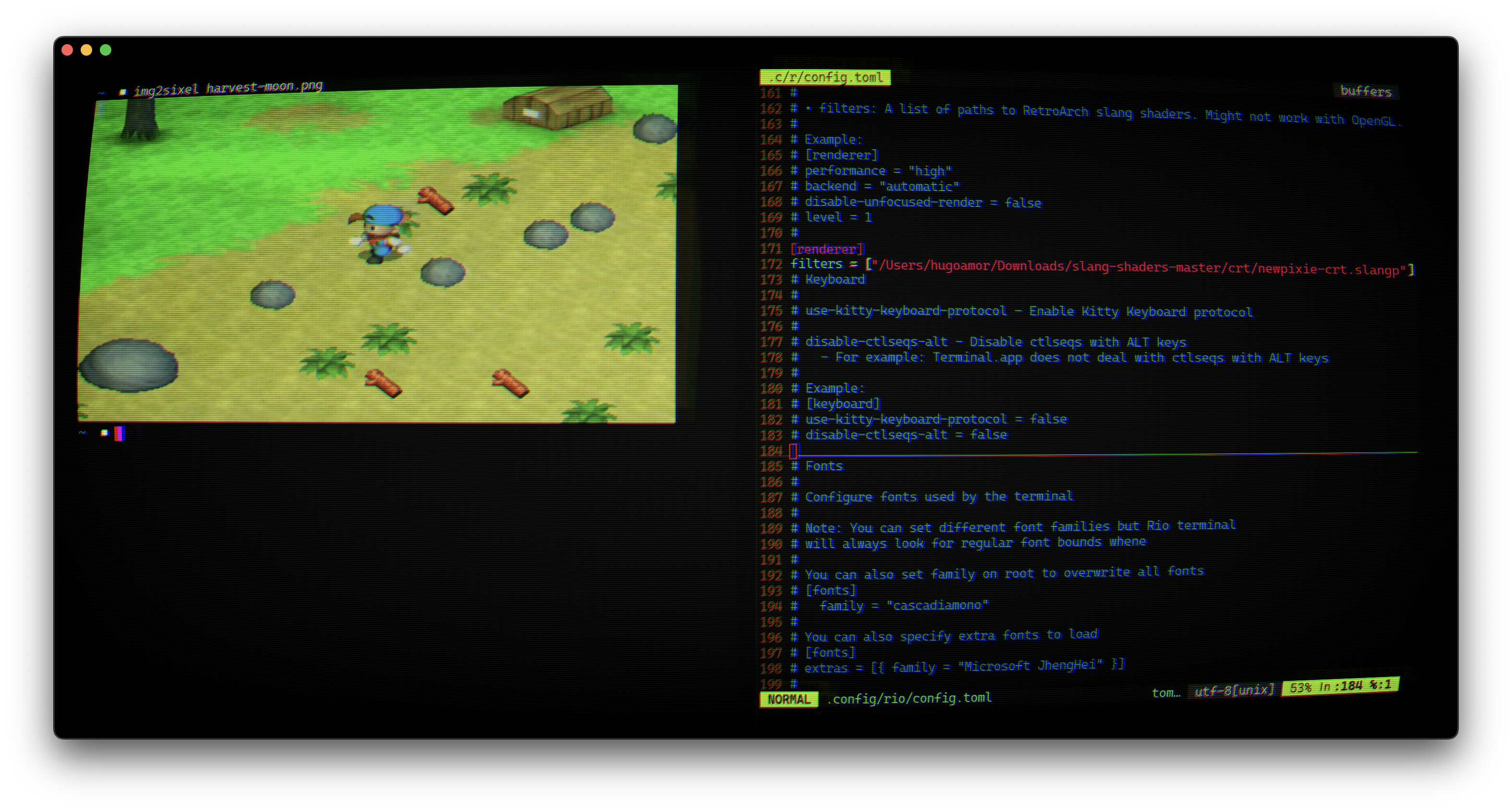
Demo with split and CRT on MacOS
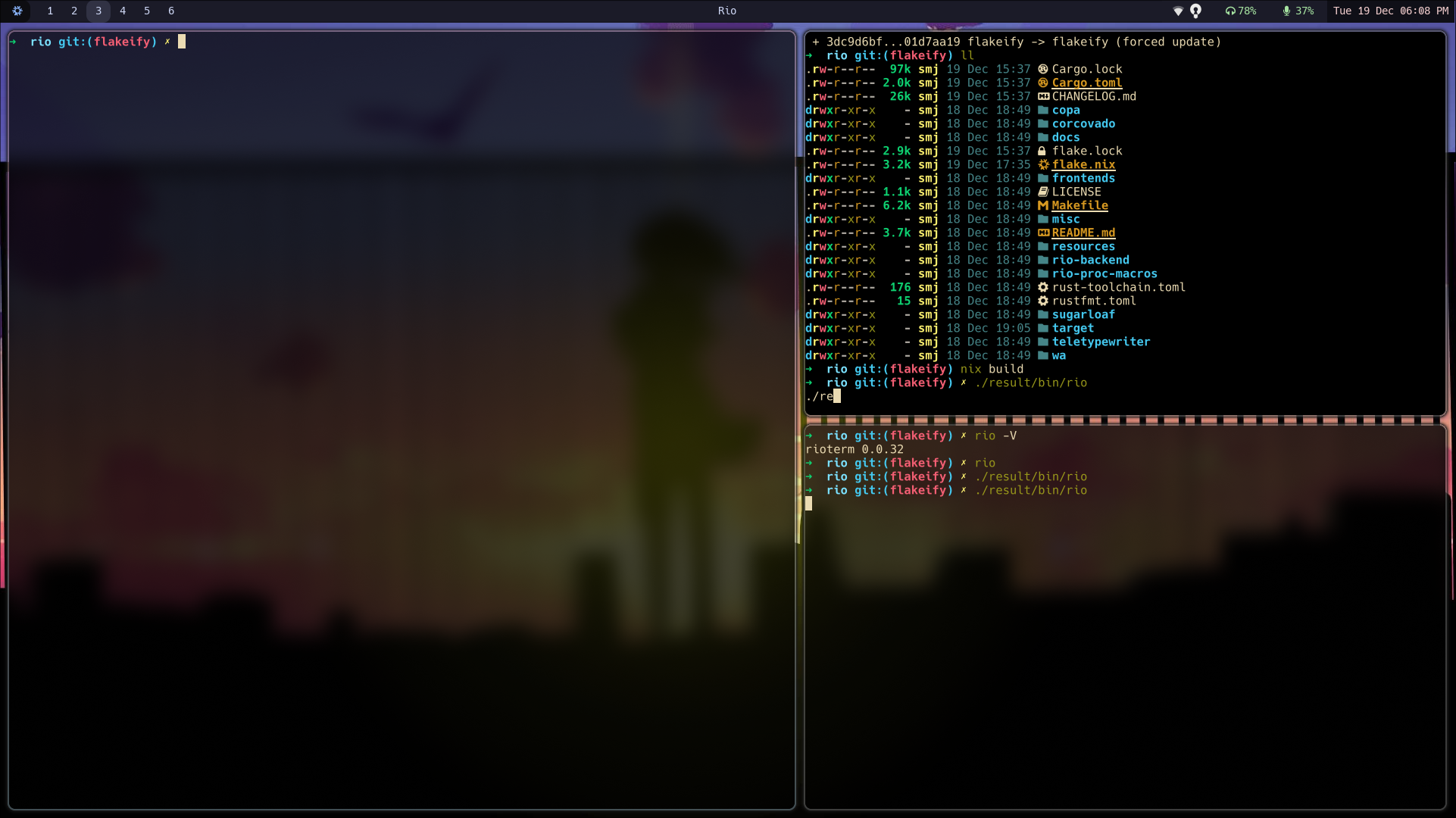
Demo with blurred background on Linux
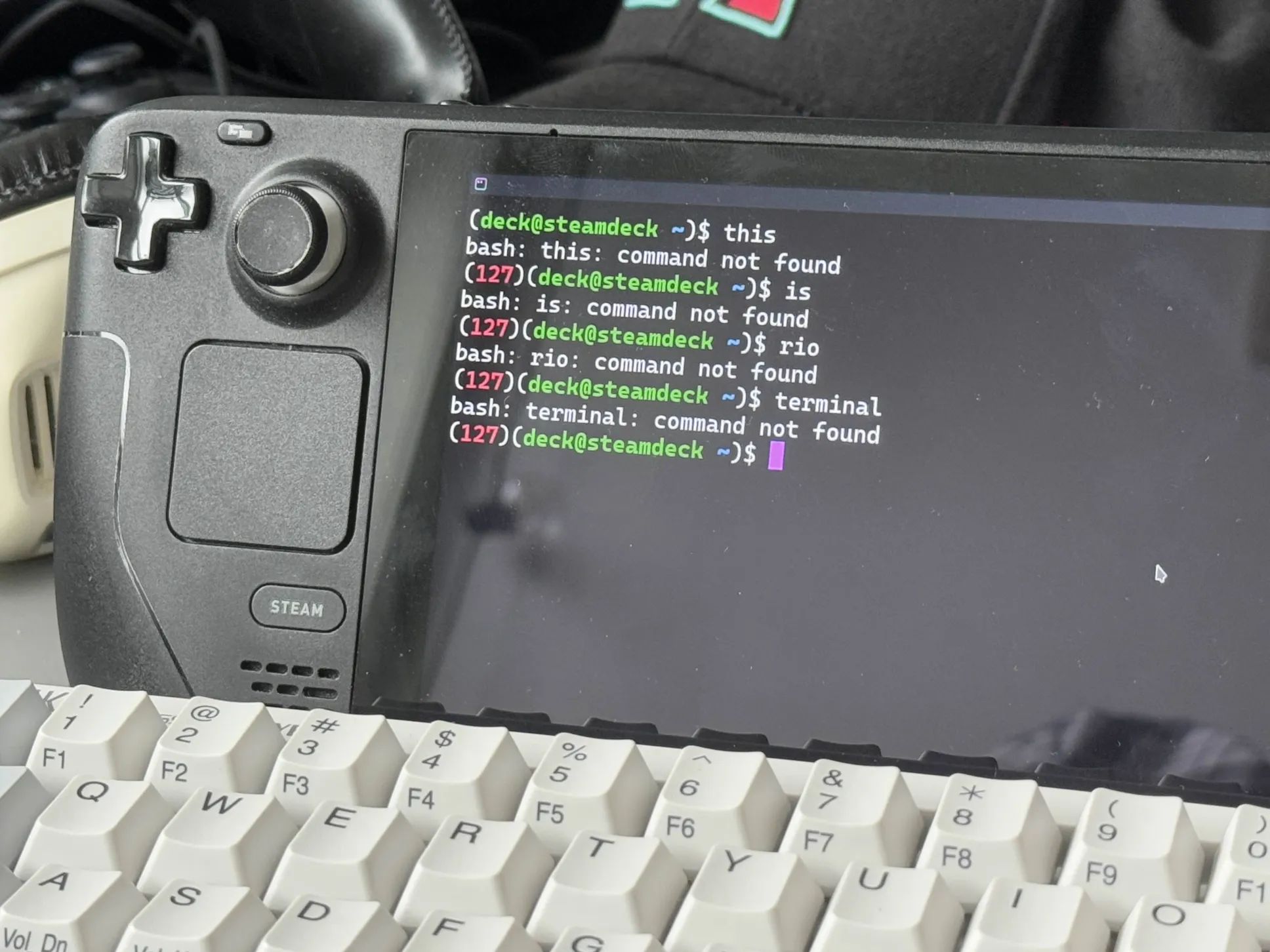
Demo of Rio running on a Steam Deck
Rio's MSRV is 1.96.1.