
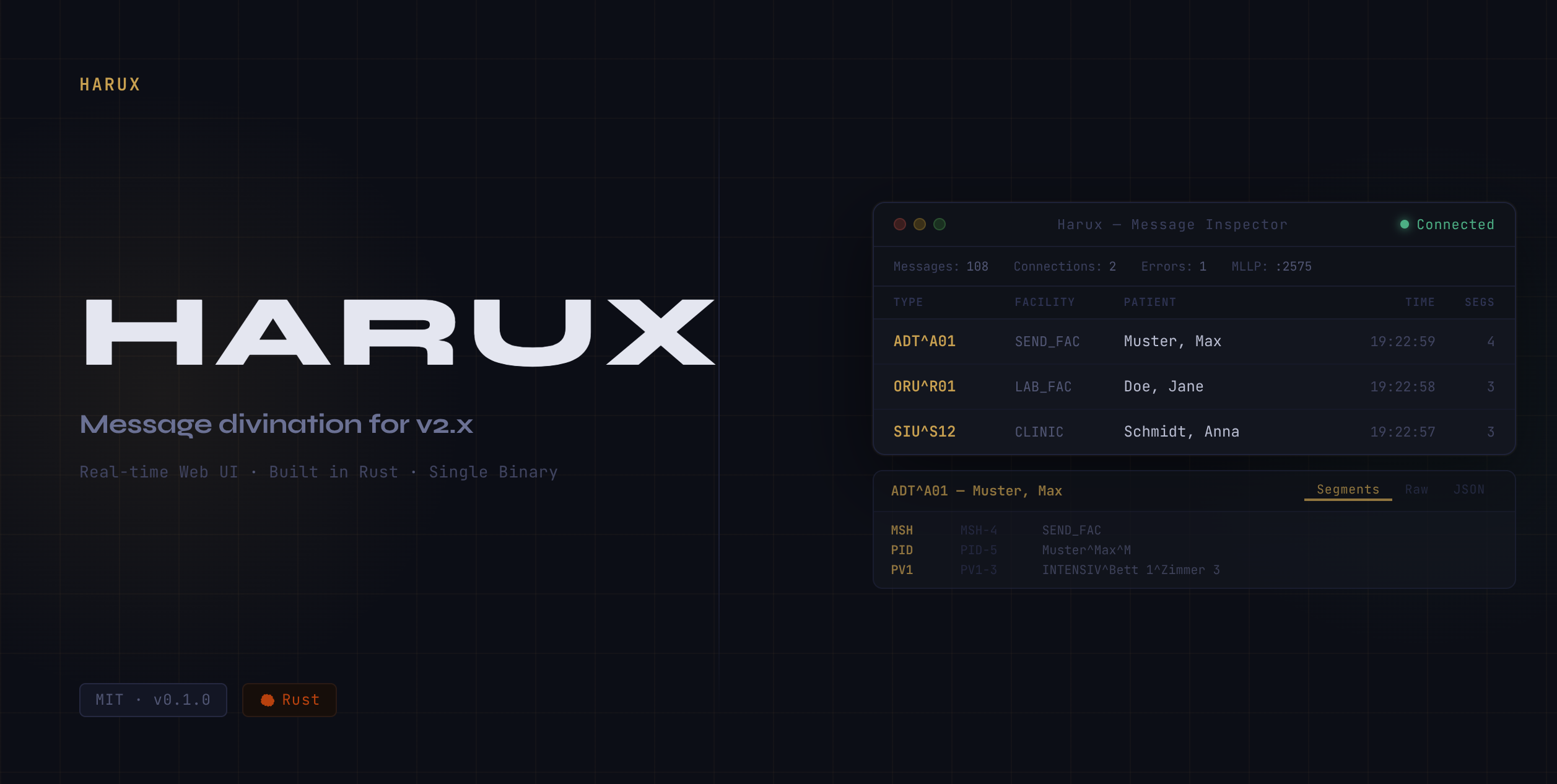


Harux is a high-performance MLLP server with a real-time web UI for inspecting HL7 v2.x messages — built in Rust, deployed as a single binary.
Designed as a drop-in replacement for HL7 Inspector: runs as a central service, accessible by your entire team via browser. No local setup. No RDP-exclusive windows.
Download · Docs · Quickstart
- MLLP Server — async TCP listener with correct
0x0B/0x1C 0x0Dframing, auto ACK/NACK - Real-time Web UI — browser SPA with WebSocket push, modern typography, two-line message layout, and time-bucket group headers
- Accessibility — full keyboard navigation (
Tabfocus) and Enter/Space activation for screen-reader and keyboard-only workflows - Deep HL7 Parser — dynamic delimiter detection, full segment/field/component decomposition
- Five Message Views — Parsed segments, Raw HL7, sent ACK/NACK, JSON, and Segment Diff
- HL7 Dictionary Tooltips — hover any field or segment header for its official HL7 v2.5.1 description; no internet required
- Message Type Detection — human-readable type description and typical segments checklist per message
- Validation Engine — warnings for missing required fields/segments (amber) and invalid field data types (blue); per message type; non-blocking, all messages are stored regardless
- Validation Filter — one-click filter to show only messages with warnings or errors; also supports
has:warnings/has:errorssearch prefixes - Segment Diff — pin any message as a reference and compare it field-by-field; optional toggle to hide always-changing dynamic fields (MSH-7, MSH-10)
- Search & Filter — global shortcut
Cmd+Kto search by message type, patient name, facility, message control ID, source IP - Bookmark & Tag — pin important messages (eviction-protected), add custom text tags
- Session-based Views — each developer sees their own filters, selection, and scroll position
- Source Rail — always-visible rail of color-coded source chips to instantly visually distinguish and filter by sender system/IP
- Smart Store — in-memory with configurable capacity and dual eviction (count + size)
- JSON Export — export full message data with one click
- Resizable Panels — drag splitter between message list and detail view
- Configurable —
harux.tomlfor ports, memory limits, timeouts, log level - Single Binary — frontend embedded via
rust-embed, zero runtime dependencies
Prerequisites: Rust toolchain
git clone https://github.com/Pappet/harux.git
cd harux
cargo build --release
cargo run --release
Open http://localhost:8080 — the UI connects automatically.
Defaults: MLLP port 2575, Web UI port 8080. Override via harux.toml or environment variables (MLLP_PORT, WEB_PORT).
# Direct start
.\harux.exe

# Install as Windows Service (NSSM)
nssm install Harux C:\Tools\harux.exe
nssm start Harux
Pre-built binaries for Windows, macOS, and Linux are available on the Releases page.
| Document | Description |
|---|---|
| PROJECT_OVERVIEW.md | Detailed architecture, technical decisions, API reference |
| ROADMAP.md | Milestones, planned features, and progress tracking |
| STYLE_GUIDE.md | UI design rules, coding conventions, workflow standards |
| CHANGELOG.md | Full history of every change |
| CONTRIBUTING.md | How to contribute |
Contributions are welcome. Please open an issue first for larger changes.
git checkout -b feature/my-feature
cargo test && cargo clippy -- -D warnings
# Submit a pull request against mainMIT — see LICENSE for the full text.
Built with Rust · github.com/Pappet/harux