

Style sheets for the GPU.
3D scenes written in CSS, compiled into a single shader for WebGL2 and WebGPU.
Website · Playground · Reference

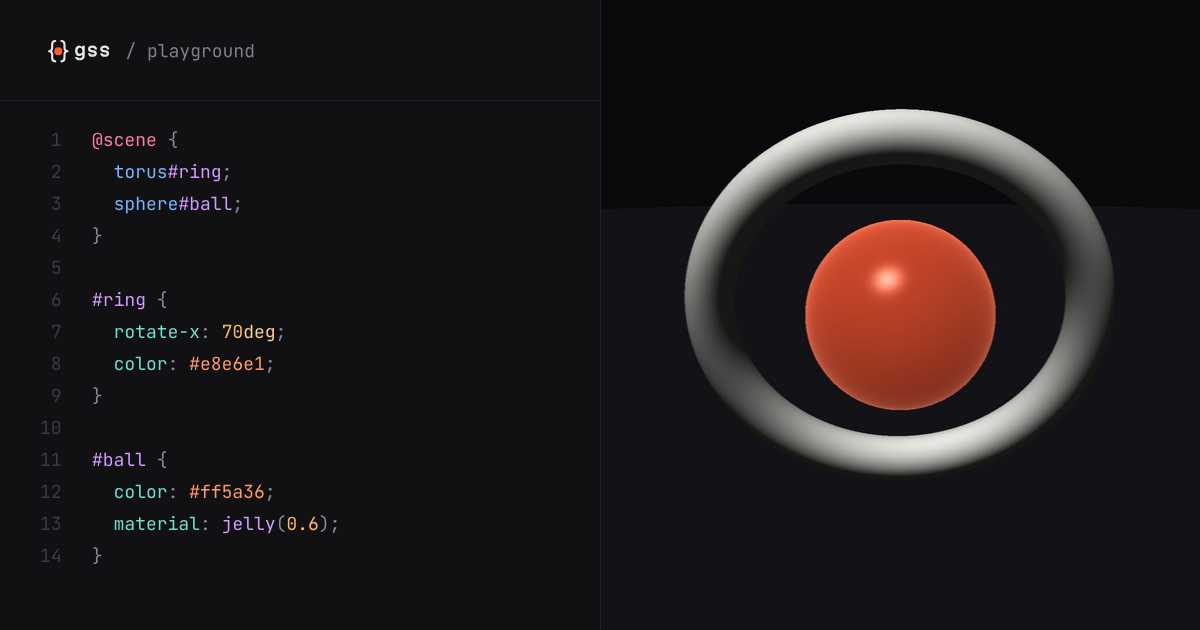
GSS (GPU Style Sheets) is a 3D language for people who already speak CSS. Declare shapes in a
@scene, style them with selectors, and the compiler turns it all into one raymarched shader.
No Three.js, no meshes.
@scene {
  torus#ring;
  sphere#ball;
}

#ring {
  translate: 0 1.2 0;
  rotate-x: 70deg;
  radius: 1.1;
  thickness: 0.14;
  color: #e8e6e1;
}

#ball {
  translate: 0 1.2 0;
  radius: 0.55;
  color: #ff5a36;
  material: jelly(0.6);
  animation: float 2s ease-in-out alternate;
}

@keyframes float {
  from { translate: 0 1.2 0; }
  to   { translate: 0 1.5 0; }
}- Getting started: why GSS, and your first scene.
- Installation: a tag, npm or Vite; WebGPU, TypeScript and the editor.
- Every page: each at-rule, selector, shape, property and function, with examples.
The same pages, with every example to edit live: gss-lang.dev/docs.
- Selectors and the cascade: classes, ids, combinators,
:hover,:has(),:nth-child(), nesting. - Shapes:
cube,sphere,torus,cylinder,cone,capsule,path,prism,latheand more. - Materials:
matte(),metal(),glass(),jelly(),emissive(),iridescent(), and textures. - Motion:
@keyframes,transition, scroll-driven animations,offset-path. - Values:
calc(),var(),@property,random()and the CSS color functions. - Effects: gradients, noise, masks, blur, bloom and grain.
- The scene: floor, background, lights, fog, shadows and an orbit camera.
- Responsive:
@media,light-dark()andif().
A tag, no build step:
<script type="module" src="https://cdn.jsdelivr.net/npm/gss-lang@0.0.7/lib/embed.js"></script>
<gss-scene src="logo.gss"></gss-scene>npm:
npm install gss-lang@0.0.7import { mount } from "gss-lang";
mount(canvas, "@scene { sphere; }");Vite, compiled at build time:
// vite.config.ts
import gss from "gss-lang/vite";
export default { plugins: [gss()] };

// main.ts
import { mount } from "gss-lang/runtime";
import logo from "./logo.gss";
mount(canvas, logo);
WebGPU, TypeScript and the editor: see Installation.
- Playground: a live editor, errors under their line, the generated GLSL and WGSL, export to Shadertoy.
- Reference: searchable, one live example per entry.
- VS Code: highlighting, formatting and snippets.
code --install-extension lukyvj.gss-language
0.0.7, early: the syntax may still change. See the changelog.
Bugs and ideas: issues or @GSS_lang. Pull requests are welcome.
npm install
npm run dev   # the site, the playground and the reference
npm test
Before a pull request, read the contributing guide: where things live, and which branch to start from.
- Signed distance functions, smooth blending and soft shadows adapted from Inigo Quilez (MIT).
- Hash functions from Hash without Sine by David Hoskins (MIT).
- Gradient noise after Ken Perlin's Improved Noise.
- Color conversions from the CSS Color 4 sample code and Björn Ottosson's OKLab.
- Editor built on CodeMirror (MIT).
- Fonts: Martian Mono, Geist and JetBrains Mono (SIL OFL 1.1).
- Zdog studies after models by Dave DeSandro; Earth and Moon maps by NASA.
texture-mapping: spherecontributed by Yoshihiro Hasegawa.