diff --git a/README.md b/README.md
index b124d7c0f..f4debc635 100644
--- a/README.md
+++ b/README.md
@@ -1,4 +1,4 @@
-# PyAutoFit: Classy Probabilistic Programming
+# PyAutoFit: Scientific Inference with Natural Language
[](https://www.repostatus.org/#active)
[](https://pypi.org/project/autofit/)
@@ -9,27 +9,29 @@
[](https://pyautofit.readthedocs.io/en/latest/?badge=latest)
[](https://doi.org/10.21105/joss.02550)
+[AI Assistant](https://github.com/PyAutoLabs/autofit_assistant) |
+[Documentation](https://pyautofit.readthedocs.io/en/latest/index.html) |
[Installation Guide](https://pyautofit.readthedocs.io/en/latest/installation/overview.html) |
-[readthedocs](https://pyautofit.readthedocs.io/en/latest/index.html) |
[Introduction on Colab](https://colab.research.google.com/github/PyAutoLabs/autofit_workspace/blob/2026.9.8.1/notebooks/overview/overview_1_the_basics.ipynb) |
[HowToFit](https://github.com/PyAutoLabs/HowToFit)
-**PyAutoFit** is a Python based probabilistic programming language for model fitting and Bayesian inference
-of large datasets.
+**Bring your models, data and likelihood code. Fit models, explore results and develop your analysis through conversation.**
-The basic **PyAutoFit** API allows us a user to quickly compose a probabilistic model and fit it to data via a
-log likelihood function, using a range of non-linear search algorithms (e.g. MCMC, nested sampling).
+[**autofit_assistant**](https://github.com/PyAutoLabs/autofit_assistant) connects natural-language requests to runnable
+**PyAutoFit** workflows. Ask it to compose a model, discuss priors, run inference or compare competing explanations.
+You guide the science; it writes and runs Python scripts you can inspect, rerun and share.
-Users can then set up **PyAutoFit** scientific workflow, which enables streamlined modeling of small
-datasets with tools to scale up to large datasets.
-
-**PyAutoFit** supports advanced statistical methods, most
-notably [a big data framework for Bayesian hierarchical analysis](https://pyautofit.readthedocs.io/en/latest/features/graphical.html).
+**PyAutoFit** is a domain-agnostic Python package for scientific model fitting and Bayesian inference. It supports
+nested sampling, MCMC and optimisation, alongside advanced methods such as hierarchical models, search chaining
+and Bayesian model comparison. The source code has an **AI First Design**; check out the
+[ReadTheDocs natural-language inference page](https://pyautofit.readthedocs.io/en/latest/overview/natural_language.html)
+for the details.
## Getting Started
The following links are useful for new starters:
+- **[Start with autofit_assistant](https://github.com/PyAutoLabs/autofit_assistant#getting-started)** to build and run inference workflows using natural language. The setup guide explains supported coding agents and access requirements.
- [The PyAutoFit readthedocs](https://pyautofit.readthedocs.io/en/latest), which includes an [installation guide](https://pyautofit.readthedocs.io/en/latest/installation/overview.html) and an overview of **PyAutoFit**'s core features.
- [The introduction Jupyter Notebook on Colab](https://colab.research.google.com/github/PyAutoLabs/autofit_workspace/blob/2026.9.8.1/notebooks/overview/overview_1_the_basics.ipynb), where you can try **PyAutoFit** in a web browser (without installation).
- [The autofit_workspace GitHub repository](https://github.com/PyAutoLabs/autofit_workspace), which includes example scripts demonstrating **PyAutoFit**'s features.
@@ -52,94 +54,25 @@ content pitched at undergraduate level and above.
The lectures are available in the [standalone HowToFit repository](https://github.com/PyAutoLabs/HowToFit).
-## API Overview
-
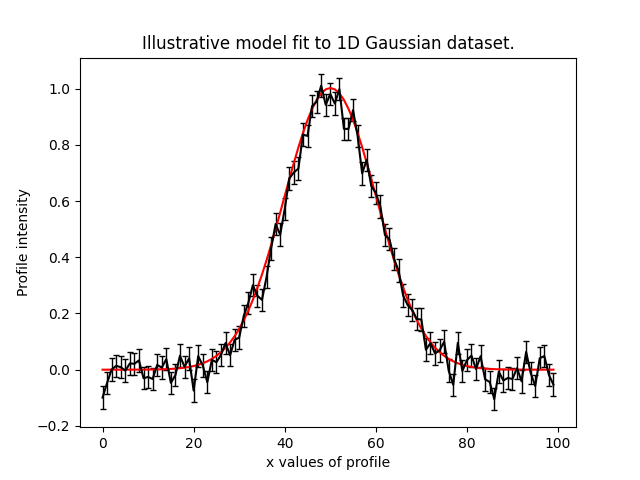
-To illustrate the **PyAutoFit** API, we use an illustrative toy model of fitting a one-dimensional Gaussian to
-noisy 1D data. Here's the `data` (black) and the model (red) we'll fit:
-
- -
-We define our model, a 1D Gaussian by writing a Python class using the format below:
-
-```python
-class Gaussian:
-
- def __init__(
- self,
- centre=0.0, # <- PyAutoFit recognises these
- normalization=0.1, # <- constructor arguments are
- sigma=0.01, # <- the Gaussian's parameters.
- ):
- self.centre = centre
- self.normalization = normalization
- self.sigma = sigma
-
- """
- An instance of the Gaussian class will be available during model fitting.
-
- This method will be used to fit the model to data and compute a likelihood.
- """
-
- def model_data_from(self, xvalues):
-
- transformed_xvalues = xvalues - self.centre
-
- return (self.normalization / (self.sigma * (2.0 * np.pi) ** 0.5)) * \
- np.exp(-0.5 * (transformed_xvalues / self.sigma) ** 2.0)
-```
-
-**PyAutoFit** recognises that this Gaussian may be treated as a model component whose parameters can be fitted for via
-a non-linear search like [emcee](https://github.com/dfm/emcee).
-
-To fit this Gaussian to the `data` we create an Analysis object, which gives **PyAutoFit** the `data` and a
-`log_likelihood_function` describing how to fit the `data` with the model:
-
-```python
-class Analysis(af.Analysis):
-
- def __init__(self, data, noise_map):
-
- self.data = data
- self.noise_map = noise_map
-
- def log_likelihood_function(self, instance):
-
- """
- The 'instance' that comes into this method is an instance of the Gaussian class
- above, with the parameters set to values chosen by the non-linear search.
- """
-
- print("Gaussian Instance:")
- print("Centre = ", instance.centre)
- print("normalization = ", instance.normalization)
- print("Sigma = ", instance.sigma)
-
- """
- We fit the ``data`` with the Gaussian instance, using its
- "model_data_from" function to create the model data.
- """
-
- xvalues = np.arange(self.data.shape[0])
-
- model_data = instance.model_data_from(xvalues=xvalues)
- residual_map = self.data - model_data
- chi_squared_map = (residual_map / self.noise_map) ** 2.0
- log_likelihood = -0.5 * sum(chi_squared_map)
+## Inference with Natural Language
- return log_likelihood
-```
+Start with a simple example: fitting a Gaussian profile to noisy data.
+Ask [autofit_assistant](https://github.com/PyAutoLabs/autofit_assistant):
-We can now fit our model to the `data` using a non-linear search:
+> Fit the bundled 1D Gaussian dataset. Explain the model and priors,
+> use nested sampling to infer its parameters, and plot the fitted
+> profile over the data.
-```python
-model = af.Model(Gaussian)
+
-analysis = Analysis(data=data, noise_map=noise_map)
+Then extend the analysis through a follow-up request:
-emcee = af.Emcee(nwalkers=50, nsteps=2000)
+> Fit a model with two Gaussians instead. Show me the priors and
+> compare the Bayesian evidence to assess whether the additional
+> component is justified.
-result = emcee.fit(model=model, analysis=analysis)
-```
+For your own science, point the assistant to your data and existing model or likelihood code.
-The `result` contains information on the model-fit, for example the parameter samples, maximum log likelihood
-model and marginalized probability density functions.
+Follow the [natural-language introduction](https://pyautofit.readthedocs.io/en/latest/overview/natural_language.html)
+for the complete workflow, or see [The Python API](https://pyautofit.readthedocs.io/en/latest/overview/python_api.html)
+for PyAutoFit's Python interface and inner workings.